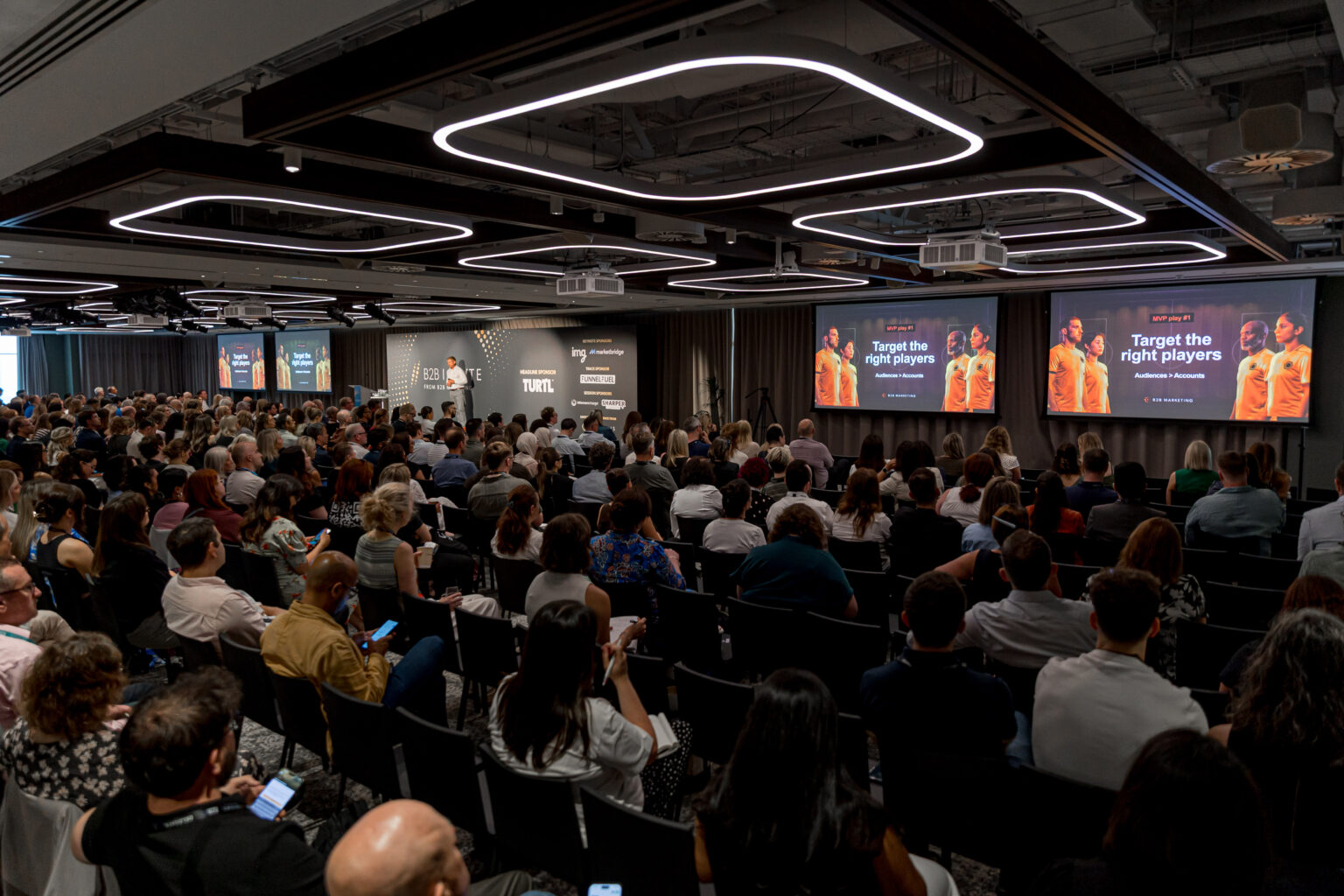
Hundreds of B2B marketers gathered at our new venue in St Paul’s for B2B Ignite 2026. Against a backdrop of accelerating AI adoption, increasing commercial scrutiny and evolving buyer expectations, this year’s conference combined inspiring keynote presentations, practical workshops, peer discussions and live demonstrations.
One of the defining moments of the event was the launch of our Propolis AI, the first AI assistant built specifically for B2B marketers and powered by our proprietary intelligence. More than a product launch, it illustrated one of the day’s central themes: AI delivers the greatest value when it improves marketing judgement, not simply content production.
Across four content tracks spanning Leadership, Demand, Brand and Tech, delegates moved between keynote presentations, customer case studies and interactive sessions designed to solve today’s commercial challenges.
Together, the agenda reflected a shift in B2B marketing: more strategic, more commercially accountable and increasingly focused on turning AI into measurable business value.
Marketing Value Under Greater Scrutiny
B2B Ignite 2026 opened with a thought-provoking keynote from our CEO, Richard O’Connor, who examined the changing realities facing today’s marketers. Drawing on exclusive research, Most Valuable Player? How B2B Marketers Can Take More Control of Growth, he argued that commercial accountability, strategic influence and alignment with business goals are becoming the defining characteristics of high-performing marketing teams.
These themes continued in sessions including ‘What the C-Suite Really Expects from Marketing’ and ‘AI Won’t Fix Your GTM, But a System-Thinking CMO Will’, both of which challenged delegates to rethink marketing’s role as a driver of business growth rather than a communications function.
A recurring thread across the Leadership and Demand tracks was the need for closer alignment between marketing, sales and the wider business. Those conversations extended into the new Ignite Exchange, where marketers tackled real-world business outcomes instead.
In the Peer Problem-Solving Circle ‘How do I prove marketing’s value with data?’, our Propolis Strategy and Engagement Expert, Scott Stockwell, encouraged marketers to move beyond reporting activity reporting and demonstrate meaningful business outcomes instead.
The discussion reflected a broader shift in the profession. Marketing leaders are increasingly expected to demonstrate their contribution to pipeline, revenue and long-term growth, making attribution, measurement and cross-functional alignment strategic capabilities rather than operational concerns.
That theme continued in our Revenue Attribution Expert Michelle McCann’s session, ‘How do I connect marketing directly to revenue?’. Rather than investing immediately in new technology, delegates were encouraged to strengthen the foundations by aligning sales and marketing around shared metrics, improving data quality and making better use of existing information.
The new Leaders’ Tables built on these discussions with candid conversations between senior marketing leaders. Rather than focusing solely on lead generation, participants debated how marketing should balance customer retention, account expansion and new business acquisition, while playing a more active role in shaping commercial strategy.
Demand Generation Is Becoming Go-to-Market Strategy
The traditional boundaries between demand generation, sales enablement and go-to-market strategy are becoming increasingly blurred.
Sessions such as ‘The Glass Slipper: Crafting Buying Group Consensus’ highlighted the growing complexity of B2B purchasing decisions, where marketers need to understand the priorities of multiple stakeholders, build consensus across buying groups and support increasingly collaborative buying journeys.
That message complemented earlier discussions in ‘What the C-Suite Really Expects from Marketing’ and ‘AI Won’t Fix Your GTM, But a System-Thinking CMO Will’, both of which challenged marketers to think beyond functional optimisation.
Together with earlier discussions around executive expectations and systems thinking, the Demand track reinforced that stronger business performance comes from connecting strategy, operations, technology and measurement into a coherent revenue engine.
AI Is Moving Beyond Experimentation
AI was present in almost every conversation throughout the day, but the emphasis had clearly shifted from experimentation to implementation.
Sessions including ‘The Work Before the Prompt”, ‘Agentic AI in Marketing: Early Lessons from Other Professions’ and ‘From Vision to Execution: A Practical Guide to AI Adoption in Marketing’ reflected a move beyond curiosity into operational adoption.
The question is no longer whether marketers should adopt AI, but how they build the data, governance and operating models required to use it effectively at scale. The launch of Propolis AI brought these discussions to life. Throughout the day, delegates visited the Demo Hub and the Propolis stand to experience the platform first-hand.
They explored how it combines trusted B2B Marketing intelligence with AI to answer complex marketing questions, analyse documents, provide practical frameworks and deliver tailored recommendations. The result is better-informed decision-making across both strategic planning and day-to-day execution.
At the same time, sessions such as ‘The Creativity Advantage’ reinforced that while AI can accelerate execution, competitive advantage still depends on human insight, originality and distinctive creative thinking.
Brand and Creativity Become Even More Critical
As AI reduces the cost of producing content, differentiation increasingly depends on factors AI cannot easily replicate: distinctive positioning, memorable creative ideas, customer insight and long-term brand investment. Rather than weakening the case for brand, AI arguably strengthens it.
B2B Marketing co-founder Joel Harrison explored this theme in ‘Lights, Camera, Pipeline’, challenging marketers to rethink how they earn attention in increasingly crowded markets.
Drawing on new research and award-winning case studies, he argued that consumer-grade entertainment is no longer a “nice to have” in B2B, but a powerful way to build distinctive brands, engage buyers and improve commercial performance.
Crucially, the evidence challenged the assumption that more creative campaigns require larger budgets. Harrison showed that entertainment-led marketing outperforms traditional approaches without a cost premium.
That perspective was reinforced in sessions such as ‘When Brand Met ABM”, “Winning B2B Brand Attention in the Age of AI’ and ‘The B2B Growth Trap: Brand is Now Your Real Competitive Edge’.
Across the Brand track, speakers consistently argued that sustainable growth will come from combining intelligent technology with creativity, strategic thinking and a deep understanding of buyers.
If there was a single thread connecting the programme, it was the continued evolution of B2B marketing from a communications function into a commercial growth discipline. Whether discussions focused on AI, demand generation, brand or measurement, the emphasis remained firmly on creating measurable business value.
A More Interactive B2B Ignite
New for 2026, the Ignite Exchange transformed the conference experience by introducing Skills Studio workshops, Peer Problem-Solving Circles, Leaders’ Tables and the Tech & AI Demo Hub. Together, these new formats encouraged delegates to move beyond passive listening and actively engage with the challenges facing modern B2B marketing.
The Skills Studio complemented the keynote programme by giving delegates dedicated time to practise new techniques, test frameworks and exchange experiences with peers facing similar commercial challenges.
During the opening keynote, delegates received tickets inviting them to visit the Propolis stand and take part in the Penalty Shootout challenge, with two lucky attendees discovering golden tickets that unlocked exclusive prizes.
Looking Ahead
Perhaps the biggest takeaway from B2B Ignite 2026 was that the industry’s priorities are becoming clearer. Competitive advantage will not come from adopting more AI tools or chasing every emerging trend. It will come from combining intelligent technology with strong brands, robust data, commercial discipline and sound strategic judgement.
Across every track, speakers reached the same conclusion: AI should amplify marketing expertise rather than replace it. The organisations that succeed will be those that combine technology with strategy, creativity and measurable business outcomes.
Through keynote presentations, practical peer learning and the launch of Propolis AI, B2B Ignite 2026 gave marketers at every stage of their careers ideas they can apply immediately within their own organisations.
At the close of the conference, delegates gathered in a dedicated room with two giant screens to watch England secure a 2–1 World Cup victory over DR Congo before the evening rolled seamlessly into the much-anticipated B2B Ignite darts tournament.
Thank you to all our speakers, delegates, sponsors and exhibitors for making this year’s B2B Ignite such a success. We look forward to continuing the conversation at future events.