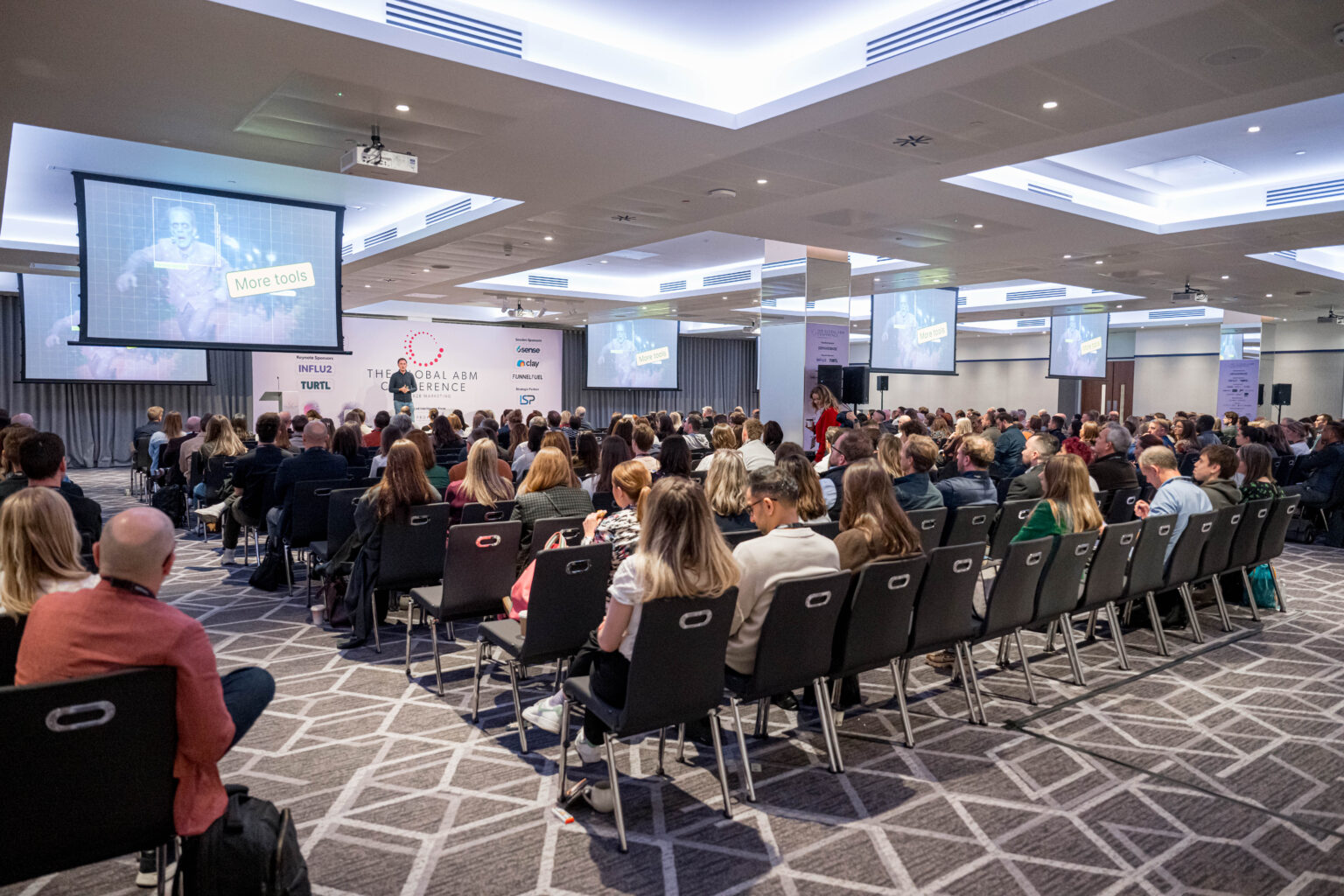
Account-based marketing is no longer the preserve of large enterprises with dedicated teams and substantial budgets. As AI lowers the barriers to execution, organisations of all sizes are exploring how to build more focused, customer-led growth strategies.
But making ABM work at scale requires more than better technology or more sophisticated campaigns. It demands closer alignment across sales, marketing and customer success, a deeper understanding of buying groups and a clear connection between customer engagement and commercial outcomes.
These questions were at the heart of The Global ABM Conference 2026, which brought together around 600 B2B attendees from across the B2B marketing industry, from global enterprise leaders to growing businesses and teams taking their first steps into ABM.
Welcoming delegates, Richard O’Connor, CEO, B2B Marketing, challenged the industry to consider how organisations can scale ABM without losing the depth, trust and personalisation that make it effective. His central message was that ABM must be a shared responsibility across marketing, sales and customer success, rather than a programme owned by marketing alone.
B2B Marketing co-founder and ambassador, Joel Harrison, widened the discussion with a perspective on how trust and influence are reshaping the B2B buying journey. As buyers increasingly turn to AI, social channels and independent voices rather than relying solely on supplier-led content, marketers need to rethink where influence sits and how they build credibility.
The people shaping a buying decision may be employees, subject-matter experts, customers or external voices who have never engaged with a campaign. Understanding and influencing this wider ecosystem is becoming increasingly important.
Across four conference tracks, keynote sessions and practical workshops, three themes emerged: start with the customer, use AI to scale what works and connect marketing activity to commercial growth.
1. Start with the customer, not the campaign
The opening keynote, “The Go-To-Market Operating System”, set the tone. Kate Philpot, Managing Director, Capability Consulting, joined Robert Norum, Propolis ABM and Demand Strategy Expert, to explore how businesses can put customers at the centre of their go-to-market strategy.
Their argument reflected a fundamental shift in B2B buying behaviour. Buying groups are becoming more complex, preferences form long before a supplier is contacted and the people influencing a decision are not always visible to marketing teams.
ABM therefore needs to extend beyond acquisition into retention, expansion and strategic relationships. Existing customers remain a major source of revenue, making it essential for organisations to bring sales, marketing and customer success together around shared objectives, clear accountability and common measures.
Without these foundations, alignment is little more than an aspiration. Understanding the wider buying group was also central to a discussion involving Emma Greene, VP, Integrated Marketing EMEA, Guidewire Software; Angus Milledge, Head of New Business Sales EMEA, SAP Concur; and Paul Gibson, SVP, EMEA Sales, Demandbase.
As buyers increasingly use large language models (LLMs) to research suppliers and visit corporate websites less frequently, traditional intent signals reveal only part of the picture. Marketers need to combine platform data with insight from sales teams, existing customer relationships and partner networks to understand what is happening in the dark funnel.
“Both marketing and sales are being tracked in terms of pipeline and how well pipeline is converting into revenue.” Emma Greene, VP, Integrated Marketing EMEA, Guidewire Software
Other discussions pushed this thinking further. Speakers from Dentsu, Salesforce and ProspectBase explored how buying decisions can be made long before identifiable intent signals, while another session challenged whether ABM has made marketers worse at following the buyer.
Mandy Carter, SMB Global Marketing Lead, Partner Strategy, AWS, and Kate Eighteen, Senior Director, Demand Center Operations, Equinix urged marketers to treat their account lists as hypotheses, rather than fixed assumptions.
Procurement and finance can hold considerable influence without appearing among the most visible contacts, while referrals and personal relationships can reveal opportunities that digital data will never capture. Mandy summed up the challenge:
“You don’t ever know who’s at the table until you actually get to the table.” Mandy Carter, SMB Global Marketing Lead, Partner Strategy, AWS
Intent shows interest, but not necessarily authority or readiness to buy. Account selection is an ongoing discipline, involving sales, revisiting assumptions and testing what the data suggests through real conversations.
This means looking beyond who is engaging with campaigns to understand who is shaping decisions, what matters to them and where the real commercial opportunity lies.
2. Use AI to scale what works, not to replace strategy
AI featured prominently throughout the conference, but the strongest discussions moved beyond the technology itself to examine the processes, data and human judgement needed to make it effective.
The AI and Data track explored why so many AI initiatives fail to scale, with speakers from JIM AI and mavenB2B examining the challenges of adoption, while contributors from Clay and Tungsten Automation demonstrated how teams are developing systems and in-house studios that sales can trust.
Google Cloud’s Alice Clarke, Rafael Cathoud and Emily Viner offered particularly compelling evidence of what agentic AI can achieve in practice. Their team used AI agents to expand an initial pilot from four accounts to 16, reducing planning time from a full day to just one hour.
Dedicated agents also helped increase the number of European events from six to 24, saving 240 hours of manual work. These results demonstrate where automation can make a practical difference: research, planning and repeatable execution.
But the gains depend on clean data, clear guardrails and human oversight. Automating a flawed process simply produces irrelevant activity faster. The wider implication is significant for organisations at every stage of ABM maturity.
AI can give smaller teams the capacity to undertake research and personalisation that would previously have been beyond their resources, while enabling enterprise programmes to coordinate activity across more accounts and markets. But scale should never become the objective in itself.
The commercial opportunity lies in using automation to improve the quality, consistency and relevance of customer engagement. VodafoneZiggo demonstrated that scaling ABM is as much an organisational challenge as a technological one.
Susan Konings, Sr. Channel Marketeer, B2B Enterprise, and Eva Croonen, Sr. Digital Marketeer, B2B Enterprise, described how they moved away from campaign-led marketing towards account-based growth.
Their starting point was addressing sales scepticism and bringing sales, marketing and product teams together around shared commercial priorities. This provided the foundation for data-led account selection, regular cross-functional planning and a broader definition of performance encompassing relationships, reputation and revenue.
Crucially, the focus remained on customers’ wider business challenges rather than simply promoting products. The lesson for other organisations is that technology cannot compensate for a programme without clear ownership or customer relevance.
Before introducing more tools, teams need to agree which accounts matter, what they want to achieve and how different functions will contribute.
Personalisation by design
Making personalisation achievable at scale was another important theme, with Fujitsu offering a practical example of how to balance consistency with account-specific relevance.
Laura Rafferty, Customer Marketing Lead, Fujitsu, explained how her team developed an ABM toolkit in partnership with sales, giving representatives access to content they could adapt for individual accounts without starting from scratch.
“From the outset, we worked with the sales team to develop an ABM toolkit, allowing them to access and personalise content for specific accounts. 70% of the collateral is ready to go, and 30% can be custom-built.” Laura Rafferty, Customer Marketing Lead, Fujitsu
Fujitsu’s 70/30 model offers a useful principle for making personalisation scalable: standardise what can be standardised and reserve specialist resources for what genuinely needs to be bespoke.
Rather than treating personalisation as an entirely manual exercise, marketers can establish a reusable foundation of content and processes, then adapt the elements that matter most to individual accounts. AI can accelerate research, adaptation and repurposing, but the strategy, inputs and review process must remain sound.
This avoids two common traps: building every asset from scratch or relying on generic content that lacks relevance. The objective is not to personalise everything, but to invest human effort where it will make the greatest difference to the customer.
Nick Mason, Co-founder and CEO of Turtl, brought the discussion back to the changing role of the marketer. He warned of a “counting trap”, in which a fixation on outputs such as MQLs and MQAs reduces marketing to a set of numbers and obscures its real influence on business growth.
As automation takes on more repetitive production and measurement tasks, marketers have an opportunity to spend more time interpreting buying-group behaviour, developing strategy and making better commercial decisions.
For a small team, that might mean automating research to free up capacity. For a global programme, it could mean more consistent planning and execution across markets. In either case, the starting point should be a clearly defined business problem, not simply the availability of a new tool.
3. Proving the commercial value of ABM
Engagement, content consumption and event attendance are useful indicators, but none is the end goal. The real test is whether ABM moves accounts forward, strengthens relationships, influences pipeline and contributes to revenue.
Sessions involving Merck, BT, Cisco and other organisations explored different aspects of this challenge, from translating insight into sales action to building buying-group influence that can be understood and demonstrated at board level.
Credibility starts with sales. Lisa Ocharo, ABM Manager, Merck, argued that representatives should have a meaningful role in selecting target accounts, ensuring they understand and take ownership of the priorities.
Intelligence then needs to translate into action. Rather than simply sharing intent data or reporting activity, marketers should provide clear recommendations, ready-to-use outreach templates and concise updates that help salespeople decide what to do next.
ABM earns its place when it makes sales more effective, not when it adds another process to manage. The closing keynote explored another dimension of this: the commercial judgement and resourcefulness needed to make ABM successful.
Gabriella Sellers of EY, in conversation with Cat Dutton, Vice President, Global Growth Marketing, Pega, described how EY’s global Marketing Excellence for Accounts team supports around 20 key accounts without a dedicated budget. Its role is to connect people, expertise and existing resources to the opportunities that matter most, a function Gabriella described with humour:
“We joke that our ABM team operates as professional BMCs [Brand, Marketing and Communications] and professional spoon-feeders.” Gabriella Sellers, Global Marketing Excellence for Accounts Leader, Brand, Marketing and Communications, EY
When hiring, she values curiosity, commercial instinct and a high-performance mindset, sometimes above prior ABM experience. The team also tracks rapport as a fourth “R” alongside reputation, relationships and revenue, offering a broader view of how trust develops over time.
The example reinforces an important point for organisations of all sizes: effective ABM does not necessarily require a bigger budget or a larger team. It requires a clear understanding of where the commercial opportunity lies and the ability to mobilise the right people and resources around it.
Beyond the stage: Where expertise meets exchange
Measurement also featured in the practical discussions across the programme. A particular challenge for ABM teams is demonstrating the contribution of experiential activity, from executive dinners and roundtables to roadshows and other high-value interactions.
These experiences can influence buying groups and strengthen relationships, but their impact is often difficult to capture through conventional digital metrics. Michelle McCann, Propolis Revenue Attribution and Commercial Marketing Expert, contributed her expertise on this challenge as part of the ABM Exchange.
Her Revenue Trail model provides a practical framework for building evidence into experiential ABM from the outset. The principle is simple: attribution should be designed in, not reconstructed afterwards.
The ABM Exchange brought together advanced practitioners to discuss building an AI-driven go-to-market engine and closing the CEO-marketing gap. The ABM Garage offered one-to-one expert advice, allowing delegates to put their programmes through an MOT covering content, personalisation, channels, ownership and measurement.
Propolis experts Robert Norum, Barbara Stewart, Scott Stockwell and Michelle McCann contributed their knowledge and experience across the conference and ABM Exchange, helping delegates explore the practical implications of the discussions and challenges facing their own programmes.
Sponsors added energy to the event with interactive stands and activations, including a Dardo machine and a Back to the Future-themed experience. Radish hosted post-event drinks, providing another opportunity to continue the conversations.
ABM is a business growth discipline
Perhaps the most telling feature of this year’s conference is how organisations can be structured to make ABM deliver growth. Do sales teams have a genuine voice in account selection? Is the data reliable enough to support automation? Does measurement capture the influence marketing has on buying decisions, rather than simply the activity it generates?
ABM is maturing from a marketing tactic into a business-wide operating model. Technology alone no longer separates strong programmes from weak ones. The differentiator is judgement: knowing which accounts deserve attention, who really influences a decision and when a signal represents genuine buying intent rather than noise.
As AI takes over more repeatable work, the opportunity is to make ABM more valuable, not simply to do more of it. Organisations that combine customer insight, human judgement and commercial accountability will be best placed to turn that opportunity into sustainable growth.