As artificial intelligence (AI) transforms B2B marketing, organisations are faced with a crucial question: what does the marketing team of the future look like? Pete Mikeal, VP of Marketing for North America, Globant, and Jarmila Yu, Founder & Consulting CMO, Strategy & Marketing Talent Specialist, YUnique Marketing Ltd, provide a unique lens into how AI is augmenting, rather than replacing, human creativity.
AI is no longer a future consideration. It is reshaping workflows, customer expectations and the very makeup of marketing teams today. “The marketing team as a whole is still going to be the power behind how you go to market and build campaigns,” Pete explains.
“AI is certainly the complement to that. How does it fill the gaps? How does it amplify the work?” For B2B marketers, this balance between human intuition and technological capability is becoming increasingly critical.
Considering the proliferation of AI tools, teams can feel overwhelmed. Jarmila argues that the real differentiator is how marketers integrate AI into their thinking, not just their workflows:
“An AI-enabled B2B marketer is someone who uses AI not just to accelerate tasks but to elevate their strategic contribution. It’s less about tools and more about operating with a mindset that blends solid marketing fundamentals with emerging capabilities.”
Enhancing Teams’ Capabilities with AI Tools
Once the mindset is established, the next challenge is operationalising AI across teams, an evolution that requires both cultural readiness and disciplined experimentation. The adoption of AI in marketing is not just about deploying tools but embedding them into the culture and processes of an organisation.
Pete recounts how his company began its AI journey over a decade ago, long before AI became mainstream:
“Our CEO tasked every single person to educate themselves in their own area, whether it’s finance, marketing or sales, to learn the tools and how to implement them. That journey started more than ten years ago, and now marketing has a plethora of tested tools at its disposal.”
He stresses that leaders need to identify the tools that best serve their organisation and scale from there, ensuring AI complements rather than overrides the human element. “At the end of the day, it’s about amplifying and enhancing the work being done,” he adds.
In practice, this approach has tangible benefits in demand generation and brand-building. From optimising websites to leveraging content, AI helps marketing teams generate leads more efficiently while freeing up human talent for creative and strategic tasks.
Yet, as organisations expand their AI stacks, the risk of over-adoption becomes real. Jarmila stresses that AI is not just about software decisions, but a set of choices grounded in business goals, customer insight and commercial impact:
“We need to evaluate all the AI tools being thrown at us… one size doesn’t fit all. It’s the marketer’s strategic capability that determines where AI fits or where it doesn’t.”
Preserving Creativity and Emotional Intelligence
However, even with the best tools in place, the competitive edge in B2B marketing still comes from a uniquely human capability: creativity.
Despite AI’s growing capabilities, Pete is adamant that human creativity remains irreplaceable. “At the core, it’s essential to evoke emotion. You have to transmit what you’re really trying to get across to your audience,” he says.
AI can support this mission by enhancing quality and clarity without compromising the human touch. For example, it can improve video resolution or audio quality, translate messaging into other languages and streamline repetitive tasks, all while keeping the narrative intact.
Pete believes that marketers who succeed with AI will be those who can use it to tell a compelling human story. “The brands that will really win the day are the ones that capture the human element,” he explains. As highlighted in LinkedIn’s Top 5 B2B Advertising Big Ideas in 2026, by Davang Shah, VP of Marketing:
“The most effective marketing teams won’t be choosing between AI and human creativity; they’ll be mastering a blend of both.”
While AI handles operational tasks, human creativity and strategic insight remain central to effective marketing. Jarmila also sees creativity as a strategic process, but one that AI can actually support: “AI can help us become more creative. By automating repetitive tasks, we free up space to think differently and build more emotionally resonant ideas.”
As AI becomes more deeply embedded in workflows, the structure and expectations of marketing teams naturally shift, raising important questions about skills, roles and long-term career paths.
Reskilling and Structuring Teams for AI
Marketing roles are always evolving, but with AI becoming more and more prominent, many people express concerns about their job security. Jarmila notes that “certain tasks will be replaced by AI, but not entire roles.” Nonetheless, she highlights a structural challenge: the disappearance of traditional junior-level work.
“The real issue is that entry-level jobs are drying up. We need to redefine what those roles look like so we can bring new talent into the profession.”
Jarmila argues that before hiring externally, marketing leaders should reassess how AI changes the skills and responsibilities within existing teams and upskill from within. This is where operational leadership becomes critical, ensuring AI enhances team capability rather than fragmenting it.
Pete stresses that his team’s AI adoption is integrated into roles rather than siloed as specialised positions:
“We don’t really have a lot of specialised roles; we all wear many hats. AI is built into our roles and our culture. In the future, we could carve out specialised AI roles, but right now it’s about embedding it into the team’s workflow.”
When hiring, creativity remains paramount. AI fluency is expected, but Pete values how candidates leverage AI creatively over technical certifications:
“Anyone can take an AI training course. For us, it’s more about how you use the tools in new, creative ways and maintain that human element.”
Internal training is also critical for staying ahead. Pete notes that the company routinely runs contests and workshops to encourage the team to explore AI tools, fostering both engagement and innovation. But as with any transformative technology, AI adoption must be balanced with responsibility, governance and clear measures of value.
Mitigating Risks and Measuring ROI
With AI adoption comes risk, ranging from data privacy issues to the potential for misinformation. Jarmila cautions that when it comes to governance, each marketer has responsibility in safe usage, risk awareness and ethical judgment:
“People think the content they upload into AI tools is locked down, but unless it’s enterprise-level… that content is out there. Understanding the risks and having clear policies in place is essential.”
Globant has a strategic approach of internal protocols and external agency partnerships to safeguard brand integrity. While acknowledging the challenges, Pete stresses that governance frameworks and careful tool selection are essential.
Measuring ROI is another area still evolving in AI marketing. “It’s very early stages to understand the true value of AI,” he admits. However, his team has seen success through initiatives like internal contests for lead generation campaigns, which allowed them to test frameworks, measure results and implement winning strategies across the organisation.
LinkedIn’s Top 5 B2B Advertising Big Ideas in 2026 highlight that credibility is the new media plan, a shift reinforced by 6sense research showing that 94% of B2B buyers used LLMs during their 2025 buying journey.
If your brand isn’t visible in AI-generated answers, it risks being excluded from consideration, making credibility and discoverability critical for future pipeline and ROI.
Future-Ready B2B Marketing: Networks and Resources
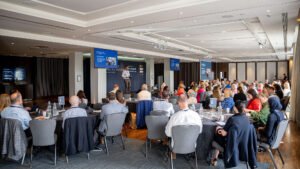
Looking ahead, Pete highlights the importance of staying connected with industry networks (we highly recommend Propolis) and thought leadership. “There’s huge value in accessing content, networking groups, roundtables and summits to share ideas and learn from other organisations, whether B2B or B2C,” he says.
He emphasises that continuous learning is critical as AI continues to evolve. “It’s moving fast, so you have to make sure you’re keeping on top of it.”
For global B2B marketers, the roadmap is clear: integrate AI thoughtfully, maintain human creativity and emotional intelligence, train teams where needed, measure ROI rigorously and select the right networks to stay ahead of emerging trends.
Across both perspectives, one theme remains consistent: technology should never overshadow the marketer’s strategic and creative judgement.
Anchoring the Human Element in an AI World
The AI-enabled marketer of the future is not defined solely by technical expertise but by the ability to fuse human creativity with technological augmentation. As Pete says, “AI is certainly a way to enhance messaging, but the human story has to be the anchor of whatever campaign you’re running.”
For marketing leaders worldwide, the task is to strike the right balance between automation, analytics and authentic human connection, building teams that are as agile and forward-thinking as the technology they employ. Jarmila sees a future where AI quietly powers the marketing engine without dominating conversations:
“When AI becomes integrated, almost invisible, we can get back to shaping powerful ideas, creating emotional connection and driving business growth. Right now we’re too obsessed with the new shiny toy. Eventually, AI will just be part of how we work.”
Ultimately, AI will reward the marketers who treat it not as a shortcut, but as a strategic force multiplier, one that sharpens thinking, elevates creativity and strengthens the commercial impact of every decision.
Check out our Propolis Artificial Intelligence Strategy Pack (Lite)