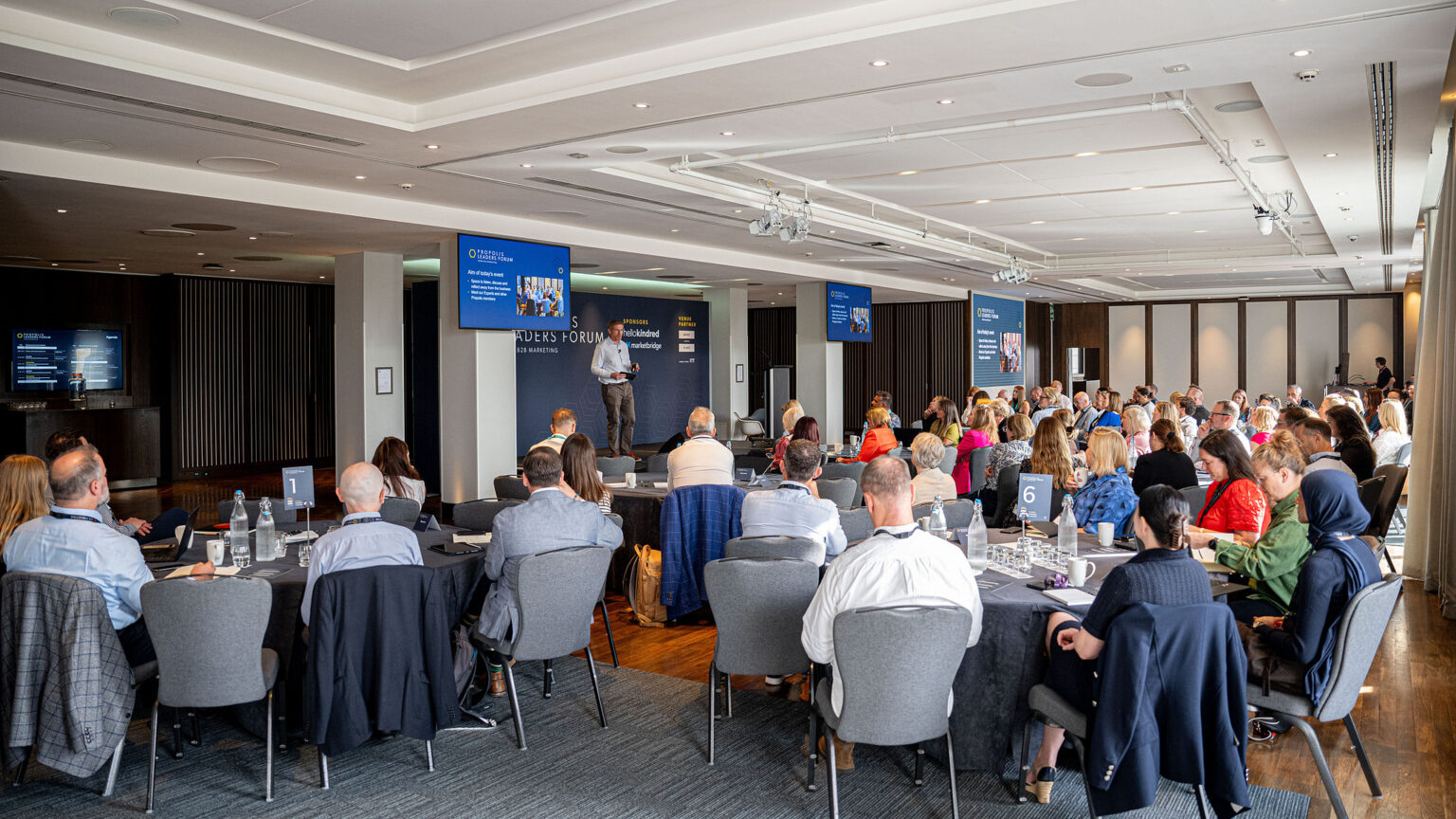
The Propolis Leaders Forum 2026 brought together CMOs and senior marketing leaders from the Propolis community at IET London: Savoy Place, a beautiful historic venue on the River Thames. Sponsored by HelloKindred and Marketbridge, the event confronted the pivotal challenges and opportunities reshaping B2B marketing.
The forum opened with a welcome from our CEO, Richard O’Connor, setting the tone for a day focused on the macro forces reshaping the profession and the practical choices marketing leaders need to make in response.
Across keynote presentations and roundtable discussions, moderated by our Propolis Experts, the event explored AI-fuelled transformation, the collapse of the traditional funnel, talent and wellbeing. AI is becoming the operating environment in which marketing happens, which is a significant opportunity, but so too is the need for a deliberate approach.
The organisations most likely to realise AI’s transformative potential will be those that look beyond the technology itself, rethinking how teams are structured, how work gets done and, ultimately, how people are empowered to work alongside AI.
The core of the discussions at the Propolis Leaders Forum revolved around seven critical insights, reflecting the practical experiences and strategic considerations of B2B marketing leaders navigating the AI era.
1. The Human-Centric AI Imperative
The most repeated idea of the day, echoed across multiple roundtables, was simple: human at the start, AI in the middle, human at the end. Kate Hassler, Group Director, Brand & Communications, The Access Group, opened the day with a keynote on how her 9,000-person, 170,000-customer organisation moved from “pockets of people experimenting with no governance” to a fully licensed AI operating model.
She said AI should own production, iteration and first drafts. Humans own the brief, the creative direction, the definition of “good,” and the final review. Her framing was particularly relevant for leaders building a business case: AI is a brilliant assistant but a terrible boss.
The distinction matters because it changes the CFO conversation many leaders in the room said they were struggling to have. When efficiency gains get treated as a headcount substitute rather than a substitute for the ramp-up period junior talent needs, organisations bank short-term savings and create long-term capability debt.
The stronger commercial argument is that AI multiplies capacity. It allows teams to spend more time on direction, creativity and higher-value decision-making. For marketing leaders, the task is to demonstrate how AI can increase organisational capability rather than simply reduce cost.
2. Strategic Application vs. Mere Efficiency
The discussions made an important distinction between using AI to save time and deploying it to fundamentally change how marketing operates. Efficiency is valuable, particularly in a constrained environment, but the greater opportunity lies in using AI to create capabilities that were previously impractical or impossible.
One marketing leader described an AI strategy backed by dedicated budget and resources, using the technology to transform large volumes of data into simple, actionable views. The objective was not simply to automate existing work, but to change how the team operates and how customers experience the organisation.
Other examples included pilots for AI SDRs and video chatbots designed to improve customer experiences and filter unqualified leads, alongside global initiatives using structured AI solutions to accelerate local marketing execution.
A B2B marketing agency had taken a similar approach to rebrand research, creating an AI-trained repository containing its background documentation. Clients could then interact directly with the system to generate ideas and stress-test brand developments.
The lesson is clear: the most valuable AI deployments unlock new strategic capabilities, improve decision-making and create competitive advantage. For B2B marketers, the question is not simply where AI can save time, but where it can fundamentally improve how the organisation understands customers, makes decisions and goes to market.
3. The Governance and Data Foundation Challenge
For many B2B organisations, the biggest barrier to AI adoption is confidence. Across the discussions, legal, data residency and regulatory concerns emerged as genuine constraints, particularly in highly regulated sectors.
Yet blanket restrictions can create a different risk. When approved tools and processes cannot keep pace with demand, employees inevitably find their own solutions, creating “shadow AI” that is harder for organisations to monitor or govern.
The more effective approach is to enable responsible experimentation through clear guardrails. This means categorising data according to risk, defining where and how AI can be used, and establishing a small, cross-functional governance group that brings together marketing, sales and other functions.
But governance alone isn’t enough. AI is also exposing the underlying quality and accessibility of organisational data. Businesses can’t build reliable AI-enabled processes on fragmented, poorly governed or inaccessible information.
Data quality, ownership and governance are strategic foundations. Marketing leaders need to address these fundamentals to move from isolated experimentation to scalable adoption.
4. The Invisible Funnel
Geoffrey Sidari, Chief Innovation Officer & Head of AI, Marketbridge, delivered a compelling session on the implications of a fundamental shift in B2B buying: up to 70% of the modern buyer journey is now invisible to traditional marketing dashboards.
The traditional “funnel” has evolved into a far more complex journey, blending LLM-led research, owned content, peer conversations and sales interactions, often across multiple touchpoints before a shortlist is even formed.
The implications are significant. 95% of purchases still come from one of four vendors already on a buyer’s day-one shortlist, while 80% of pre-contract favourites ultimately win the deal. The decisions that matter most are increasingly being made before marketers have visibility of, or direct influence over, the buying process.
Geoffrey offered a practical framework for improving AI visibility through three measures: citation share, whether your brand appears in AI-generated answers; preferred share, whether AI recommends your brand; and narrative alignment, whether AI describes your brand as intended.
Roundtable discussions reinforced the importance of content infrastructure, with leaders identifying buried headings, hidden pages and inconsistent information architecture as barriers to discoverability.
The implication is clear: marketers need to understand not only where buyers convert, but where preference is formed before the funnel becomes visible.
5. Protect the Talent Pipeline
As AI reshapes how marketing teams work, the challenge isn’t simply learning new tools, but developing the judgement, creativity and critical thinking needed to use them effectively. Leaders spoke openly about change fatigue and the need to protect training budgets for sustained AI upskilling.
A deeper concern emerged across several roundtables: “capability debt”. If organisations reduce junior hiring because AI can now produce first drafts and complete tasks traditionally given to early-career marketers, they may also remove the experiences through which future leaders develop judgement.
James Poulter, author of AI at Work: How to Build a Full Stack Organisation, made the point during a fireside chat with Roland Glass, Chief Commercial Officer, HelloKindred. His observation that this transformation is unfolding in roughly 36 months, compared with 136 years of adaptation to the Industrial Revolution, underlines the scale of the leadership challenge.
As James put it: “AI will teach the skills; seniors need to teach character.” The response is not to slow AI adoption, but to rethink development.
Give junior marketers meaningful ownership in safe environments, pair them with confident AI users and prioritise critical thinking, problem-solving and brand judgement alongside AI fluency. Efficiency today must not come at the expense of capability tomorrow.
6. Resilience and Wellbeing in Leadership
The impact of transformation cannot be separated from the people expected to deliver it. Justina Gilbert, Chief Compassion Officer & Founder, Beacon Mindset, brought this into sharp focus with a wellbeing session highlighting the scale of burnout among employees and managers globally.
Her message was particularly relevant in the context of AI: resilience is “not stoicism, it’s knowing when to ask for help.” At a time when technology can create an expectation that teams should simply produce more, faster, leaders need to distinguish genuine productivity from unsustainable intensity.
Leaders also spoke about the importance of showing vulnerability, creating genuinely open one-to-ones and separating personal identity from output volume. These are increasingly important leadership disciplines during periods of sustained organisational change.
The broader lesson is that AI transformation is as much an organisational challenge as a technological one. Marketing leaders need to create environments in which people can adapt without becoming overwhelmed, while giving teams the confidence to experiment, challenge assumptions and learn.
The strongest businesses will treat wellbeing as part of transformation design. Sustainable performance depends on giving people both the tools to work differently and the conditions to do so effectively.
7. Human Differentiation Is the Strategy
One of AI’s most compelling benefits is its ability to help marketing teams move faster and achieve more with less. An ABM leader described how her team responded to an 80% budget reduction by combining AI tools with design platforms, reducing agency dependency while expanding the scope of its global go-to-market activity.
It was a powerful example of AI increasing agility and creative reach. But the discussions repeatedly stressed that more output does not necessarily mean better marketing. Without careful oversight, AI can dilute brand authenticity, consistency and the human connection that makes communication effective.
Leaders shared examples of generic AI-generated content and emails being sent externally without sufficient human review, creating both brand and reputational risks. The closing keynote from Dr Paul Marsden, Chartered Psychologist, Synthsight, brought these threads together.
As technical execution becomes increasingly commoditised, the durable sources of differentiation shift towards distinctly human capabilities: empathy, social intelligence, curiosity, judgement and perspective-taking.
His framing of the emerging “relational economy” offers a useful strategic lens. If AI can produce content, code and campaigns at increasingly low marginal cost, competitive advantage will come from the quality of human relationships, advocacy, trust and narrative surrounding a brand.
The strategic question is therefore not whether marketing can produce more with AI, but what it should never allow AI to commoditise. The leaders most likely to navigate the next phase successfully will be those willing to experiment, learn and redesign the organisation around what they discover.
They will know what to automate, what to measure, what to protect and most importantly, where being human still matters most.
What B2B marketing leaders should take back to the business
- Move from AI experimentation to AI-enabled operating models. Identify real business problems, give teams permission to experiment and scale what demonstrably works.
- Build the human → AI → human model into your workflows. Keep human ownership around briefing, judgement, creativity, quality and final approval, while using AI to accelerate analysis, production and iteration.
- Make governance an enabler, not a brake. Establish clear guardrails and cross-functional governance so teams can experiment safely without creating unnecessary friction.
- Measure beyond the visible funnel. Establish a baseline for how your brand appears in AI answers, search, communities and earned conversations. Track influence and reputation alongside traditional pipeline metrics.
- Rebalance paid and earned influence. Customers, employees, partners, experts and communities increasingly shape what buyers encounter before they speak to sales. Build programmes that encourage genuine advocacy and third-party credibility.
- Protect the next generation of marketing talent. Use AI to augment development, not eliminate the opportunities through which junior marketers build craft, judgement and critical thinking.
- Ask whether AI is making the organisation better, not simply faster. The most valuable outcome may be stronger decisions, deeper customer understanding, greater differentiation and more time for people to do the work machines can’t.
If you want to take the conversation further and explore how AI can inform and support your B2B marketing strategy, check out Propolis AI, which combines 20+ years of B2B marketing intelligence, proprietary frameworks, benchmarking data and real-time market insight, helping marketers connect activity to commercial growth.